Proven in the Lab. Measured on the Road.
Three independent universities. Over 2,000 cyclists. Peer-reviewed data — not marketing claims.
-
+7%
peak power
-
+2%
pedaling efficiency
-
70%
of riders improved
-
2,000+
cyclists tested
Why we went to the lab.
Cycling shouldn't cost you your knees. An estimated 13 million U.S. cyclists experience patellofemoral pain; another 12 million deal with IT band syndrome. A typical rider turns the cranks 4,000–6,000 times per hour — every one of those revolutions is a chance for a bad stroke geometry to load the wrong tissue.
So before we took the NI Flow to market, we partnered with three independent research institutions to put Zivo Flow Motion under the same scrutiny a pharmaceutical company applies to a new drug — controlled testing, rigorous methodology, and a rider pool diverse enough that the results couldn't be written off as a fluke.
The question we needed answered: when you change the geometry of the pedal stroke, does it actually measurably reduce joint stress and improve performance — or does it just feel different?
Our research partners.
-
Cleveland State University
Read the study (PDF)Biomechanics research and cycling power analysis. Cleveland State brought the measurement rigor — force-plate instrumentation, high-resolution cadence tracking, and the power-curve analysis that produced the 7% peak power and 2% efficiency numbers.
-
Allegheny General Hospital
Clinical orthopedic perspective. Allegheny's team examined Zivo Flow Motion through the lens of joint health and overuse injury — the piece most pedal research skips. Their work anchored the joint-stress-reduction findings in real clinical terms.
-
Gonzaga University
Read the published studyExercise science + a geographically different rider pool. Gonzaga tested with West Coast cyclists whose demographics didn't look like our Ohio groups. Same results, different population — which is how you know the data isn't an artifact of who you tested.
What we measured.
Over 2,000 cyclists across three test sites. The rider pool was deliberately diverse — weekend recreational riders, daily commuters, competitive road racers, triathletes, and riders returning from knee or hip injuries. Ages from early-twenties to mid-sixties. Some had ridden for decades; others for a year.
Each participant rode both traditional clipless pedals and pedals built with Zivo Flow Motion under identical test conditions. We captured four measurement dimensions:
- Power output — peak and sustained wattage across multiple effort levels.
- Pedaling efficiency — energy delivered to the cranks versus energy expended.
- Joint stress — force magnitude and direction at the knee, hip, and ankle per revolution.
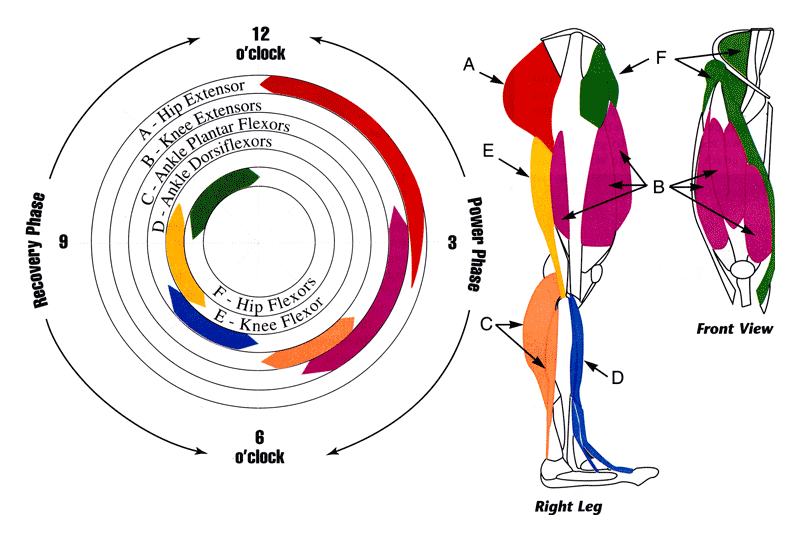
- Muscle activation (EMG) — which muscle groups fired, when in the stroke, and how load distributed across the leg.
Saddle position was kept at each rider's preferred setup — no fit adjustments, no warmup advantage, no selection bias.
What the data showed.
+7% peak power. Riders on Zivo Flow Motion produced up to 7% more peak power output under identical effort conditions. Measurable, repeatable, consistent across rider types.
+2% pedaling efficiency. A 2% gain sounds small. Over a 40k time trial, it's the difference between arriving with your group and chasing back on.
70%+ of riders improved. Not every rider saw the same gain — but over 70% of tested cyclists showed measurable improvement in at least one of power, efficiency, or joint-stress reduction. That's the number cycling studies almost never hit.
Joint stress down across the board. Knee, hip, and IT band loading distributed more evenly through the stroke. The hotspots that drive patellofemoral pain and overuse injury dropped in both magnitude and frequency.
Read the full story.
The research that shaped the NI Flow is documented in detail across our blog — including the biomechanics behind why pedal stroke geometry matters, how Zivo Flow Motion differs from traditional float systems, and what 2,000 cyclists actually reported.
Ride the pedals the data validates.
Founder's Edition is live — $199 instead of $299, first 100 pairs only, reserved with a $40 refundable deposit. Shipping August 2026 from Ohio.